Author: Sajad Khodadadi
In this paper, the motion and interaction of a bubble pair rising in a quiescent liquid are simulated using the volume of fluid (VOF) method in the OpenFOAM CFD software. The study explores coalescence, bouncing, zigzagging, and breakup phenomena based on Bond (Bo) and Morton (Mo) numbers. Validation against experimental and previous numerical studies demonstrates the model’s accuracy. Various bubble arrangements (0°, 45°, 90°) are tested, revealing the influence of bubble interactions.
Multiphase flows, including bubble dynamics, play a crucial role in industrial applications such as heat exchangers, atomization, and chemical processes. Understanding the behavior of bubble pairs is essential for predicting fluid dynamics. The current study investigates bubble interactions, including coalescence, bouncing, zigzagging, and breakup, based on the dimensionless Bond and Morton numbers.
The numerical simulation is carried out using OpenFOAM’s interFoam solver, which employs the volume of fluid (VOF) method to track the interface between liquid and gas. The governing equations include the continuity and Navier-Stokes equations, with surface tension modeled using the continuum surface force (CSF) method.
The bubble pair simulations are performed in a 2D domain. Boundary conditions include no-slip walls and a zero-gradient pressure condition at the outlet. Different configurations, with the angle between the bubbles set to 0°, 45°, and 90°, are tested to observe interaction dynamics.
The results demonstrate four distinct bubble interaction regimes: coalescence, bouncing, zigzagging, and breakup. Figure 1 compares the simulation results with experimental data and Figure 2 shows the bubble motion for different Bond and Morton numbers.
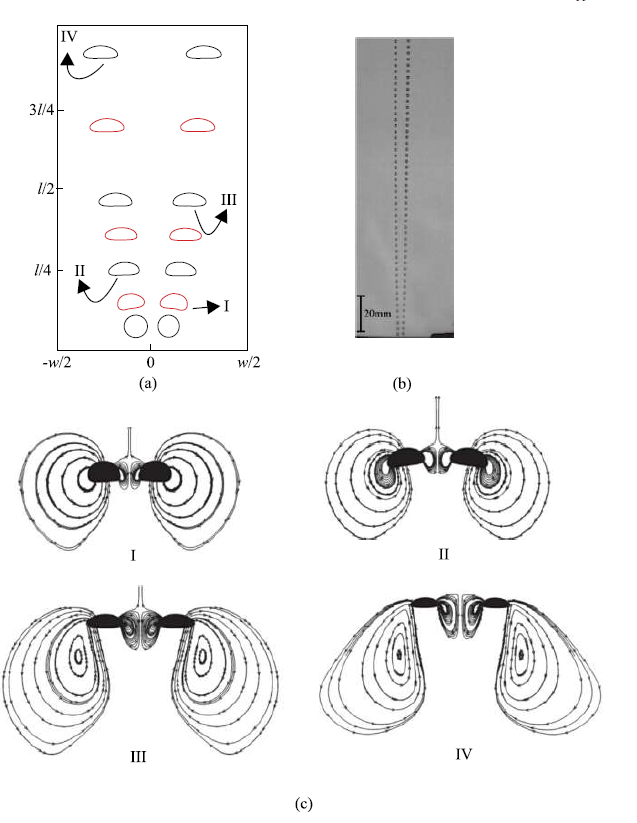
This study successfully simulates the interaction of bubble pairs rising in a quiescent liquid using the VOF method in OpenFOAM. Four distinct interaction types are observed, and the results align closely with experimental findings, particularly in predicting coalescence and bouncing behavior. Future work could extend the simulation to 3D models to capture more complex interactions.